Best AI & ML Courses in India (2026): Comparison of Popular Upskilling Platforms

Merit Path Education
Date: 13th November, 2026


AI and ML hiring in India has moved well beyond "learn Python and do a Kaggle project." Employers now ask whether you can build with LLMs, ship a model behind an API, and reason about data pipelines and deployment. That has pushed a lot of working professionals and final-year students toward structured programs. This guide compares the most commonly considered options so you can pick one based on your background, budget and goal rather than on marketing.
Quick Answer: Which AI/ML Course Fits Whom?
- Software engineers moving into AI/ML: programs that combine strong coding and system design with ML and GenAI, such as Scaler, Bosscoder and Newton School.
- Beginners from non-tech backgrounds: longer, foundation-first programs such as upGrad, Great Learning or Coding Ninjas.
- Self-driven learners on a budget: free or low-cost options such as Andrew Ng's courses on Coursera, fast.ai, NPTEL and the Hugging Face course.
- People who want a university credential: certificate or degree-style programs from upGrad, Great Learning, or IIT-linked executive programs.
No single course is best for everyone. The sections below explain why.
How We Compared These Programs
We looked at the same six things for every platform:
- Curriculum depth: Python, statistics, classical ML, deep learning, NLP, LLMs and GenAI, MLOps.
- Hands-on projects: real, portfolio-worthy builds versus guided notebooks.
- Mentorship and doubt support: who teaches and how quickly you get unstuck.
- Career support: resume reviews, mock interviews, referrals and hiring partners.
- Format and time commitment: live versus recorded, weekday evenings versus weekends.
- Cost and payment options: total fee, EMI, and any income-share or deferred-payment model.
Fees, batch dates and syllabi change often. Always confirm current details on each platform's official page before deciding.
What a Good AI/ML Curriculum Should Cover in 2026
Before comparing platforms, here is a checklist you can hold any program against:
- Foundations: Python, NumPy, pandas, probability and statistics, linear algebra basics.
- Classical ML: regression, classification, tree-based models, feature engineering, evaluation and model selection.
- Deep learning: neural networks, CNNs, sequence models, transformers.
- GenAI and LLMs: prompting, embeddings, retrieval-augmented generation (RAG), fine-tuning basics, agents and evaluation.
- MLOps and deployment: APIs, containers, cloud services, monitoring, versioning of data and models.
- Capstone work: at least one end-to-end project that you can demo in an interview.
If a program stops at notebooks and never touches deployment or LLM applications, you will likely need to learn those on your own.
Platform-by-Platform Comparison
Scaler
Best for: working software engineers who want a rigorous, engineering-first route into AI/ML.
- Strengths: strong emphasis on core computer science, system design and problem solving alongside ML; structured live classes; an active alumni and mentor network.
- Trade-offs: typically one of the higher-priced options, and the pace can be demanding if you are not already comfortable with programming.
- Consider it if: you want depth, can commit regular weekly hours, and your goal is a product-company engineering role with an AI focus.
Bosscoder Academy
Best for: engineers who want a mentor-driven, small-group program that connects DSA, system design and AI/ML.
- Strengths: emphasis on live mentorship, project work and interview preparation; programs aimed at people already working in software roles.
- Trade-offs: a smaller brand footprint than the largest edtech names, so check alumni outcomes, batch size and mentor profiles directly with the team and former learners.
- Consider it if: you value close mentor guidance and want preparation that includes both skills and interviews.
Newton School
Best for: learners who want an outcome-linked structure and a strong focus on placement preparation.
- Strengths: structured curriculum, live sessions and career-linked pathways, often with flexible payment models.
- Trade-offs: the depth of AI/ML specialization varies by program, and eligibility or placement terms should be read carefully.
- Consider it if: you are earlier in your career and want guided structure and hiring support.
Coding Ninjas
Best for: beginners and students who want a broad, fundamentals-first path with a large catalogue of courses.
- Strengths: wide range of programs, beginner-friendly pacing and a big learner community.
- Trade-offs: experienced engineers may find parts of the content introductory; check how much of the program is live versus recorded.
- Consider it if: you are starting from scratch and want to build coding and ML basics together.
upGrad
Best for: learners who want a university-partnered credential and a longer, more academic program.
- Strengths: partnerships with universities, a wide range of data science and AI programs, and options for different budgets and durations.
- Trade-offs: longer programs mean a larger time commitment; hands-on depth can differ by track.
- Consider it if: a recognized certificate or degree matters to you or to your employer.
Great Learning
Best for: professionals looking for an executive-style program with university branding.
- Strengths: programs co-branded with well-known institutions, mentor sessions and a focus on working professionals.
- Trade-offs: similar to other certificate-led programs, so confirm project depth and how much of the syllabus covers GenAI.
- Consider it if: you want a structured, credentialed route and can follow a fixed schedule.
Simplilearn
Best for: learners who want industry-certification-aligned content (cloud, AI, analytics) in a flexible format.
- Strengths: certification prep, flexible formats and a broad catalogue.
- Trade-offs: the mix of self-paced and live content varies, so check how much one-to-one support you actually get.
Free and Low-Cost Options
If your budget is tight, these can take you far, provided you are disciplined:
- Machine Learning Specialization (Andrew Ng, Coursera) for solid fundamentals.
- fast.ai for a practical, code-first deep learning approach.
- Hugging Face courses for transformers and LLM tooling.
- NPTEL for university-level lectures at very low cost.
The catch is that you must create your own projects, schedule and accountability, and there is no placement support.
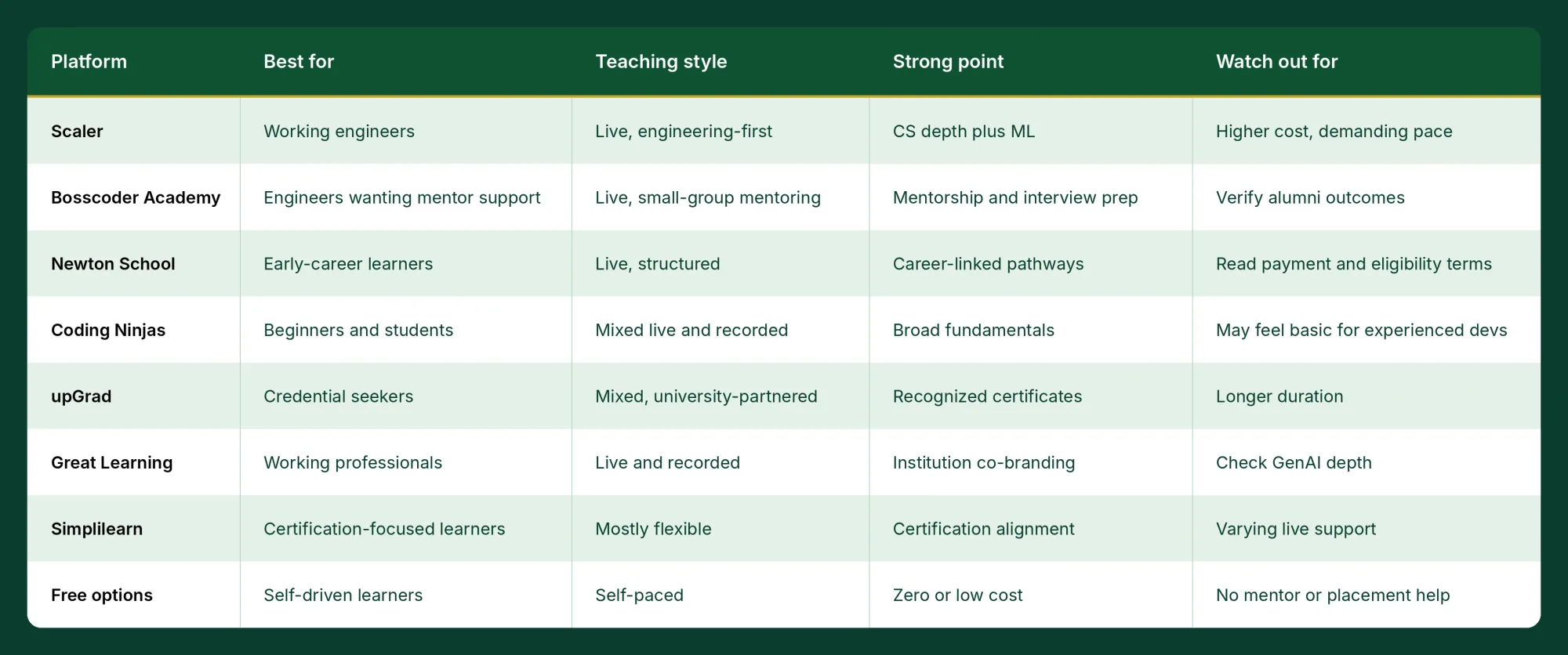
Side-by-Side Snapshot
How to Choose the Right AI/ML Course
1. Start with your current level. If you can already build backend services, pick a program that goes quickly into ML systems and GenAI. If you are new to coding, pick one that teaches Python and statistics properly.
2. Decide your target role. ML engineer, data scientist, GenAI application developer and data analyst are different jobs with different skill mixes. Match the curriculum to the role, not the other way around.
3. Check the projects. Ask to see real learner projects. A good program produces work you can put on GitHub and explain in an interview.
4. Talk to alumni. Speak to two or three past learners, ideally on LinkedIn, and ask what changed for them after the program and how long it took.
5. Read the fine print on fees and placement. Understand total cost, refund terms, EMI interest, and what "placement support" actually includes. Support is not the same as a guaranteed job.
6. Be honest about your time. A strong program you cannot keep up with is worse than a lighter one you finish.
Common Mistakes to Avoid
- Choosing only on brand name or on the loudest advertising.
- Treating salary figures on landing pages as typical outcomes. Look for the median, not the best case.
- Skipping the fundamentals and jumping straight to GenAI tools. Tools change quickly, but the fundamentals keep paying off.
- Collecting certificates without building anything.
Frequently Asked Questions
Q1. Do I need a computer science degree to learn AI and ML?
No. Many people enter from other engineering streams or from analytics roles. You do need comfort with Python, basic maths and statistics, and a willingness to build projects.
Q2. How long does it take to become job-ready in AI/ML?
For someone with programming experience, structured programs commonly run from several months to about a year. Beginners should plan for longer. Your pace and prior background matter more than the program's advertised duration.
Q3. Which is better: data science or AI/ML engineering?
Data science leans toward analysis, experimentation and insight. AI/ML engineering leans toward building and deploying models and AI-powered products. If you enjoy software engineering, the second may suit you better.
Q4. Will GenAI replace the need to learn ML basics?
GenAI tools make many tasks faster, but employers still look for people who understand evaluation, data quality, deployment and failure modes. Fundamentals remain a differentiator.
Final Verdict
There is no universal winner. Engineers who want depth and mentorship should look closely at Scaler, Bosscoder Academy and Newton School. Beginners may be better served by Coding Ninjas, upGrad or Great Learning. Self-driven learners can start free and upgrade later if they need structure. Shortlist two or three programs, attend demo sessions, speak to alumni, and decide based on fit rather than hype.
Related Blogs
Best DevOps Course in India (2026): A Practical Buyer's Guide
Date: 26th October, 20264 min read
Scaler, Newton School, Bosscoder or Coding Ninjas?
Date: 16th October, 20264 min read
Best Data Engineering Courses in India: A Practical Comparison of Popular Upskilling Platforms
Date: 13th October, 20268 min read