Best Data Engineering Courses in India: A Practical Comparison of Popular Upskilling Platforms

Merit Path Education
Date: 13th October, 2026


If you're thinking about moving into data engineering, you've probably already noticed one problem: there are too many courses. Search for a data engineering course in India and you'll find university programmes, online certifications, bootcamps, self-paced platforms and career-transition programmes. Almost all of them promise some combination of industry-relevant skills, projects, mentorship and career support.
The difficult part isn't finding a course. It's figuring out which type of course actually makes sense for you.
Someone with three years of software development experience may not need the same programme as someone coming from a non-technical background. Similarly, a working professional who can study for five hours a week has very different requirements from someone making a full-time career transition.
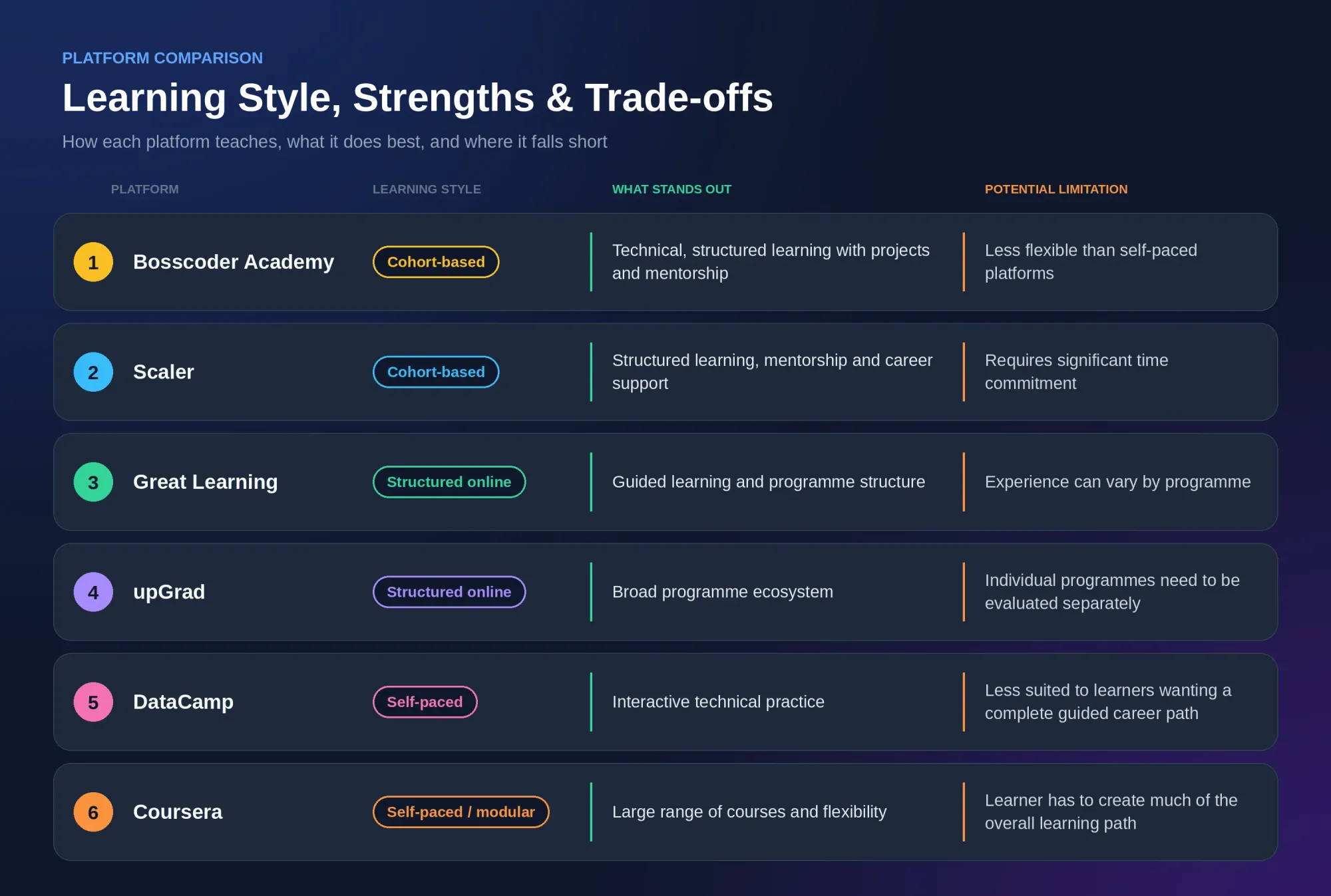
This comparison looks at six popular platforms and learning models — Bosscoder Academy, Scaler, Great Learning, upGrad, DataCamp and Coursera — and compares them on the things that actually matter when learning data engineering. Rather than calling one platform universally "the best", we've also included a learner-profile recommendation so you can see where each option makes the most sense.
First, What Does a Data Engineer Actually Need to Learn?
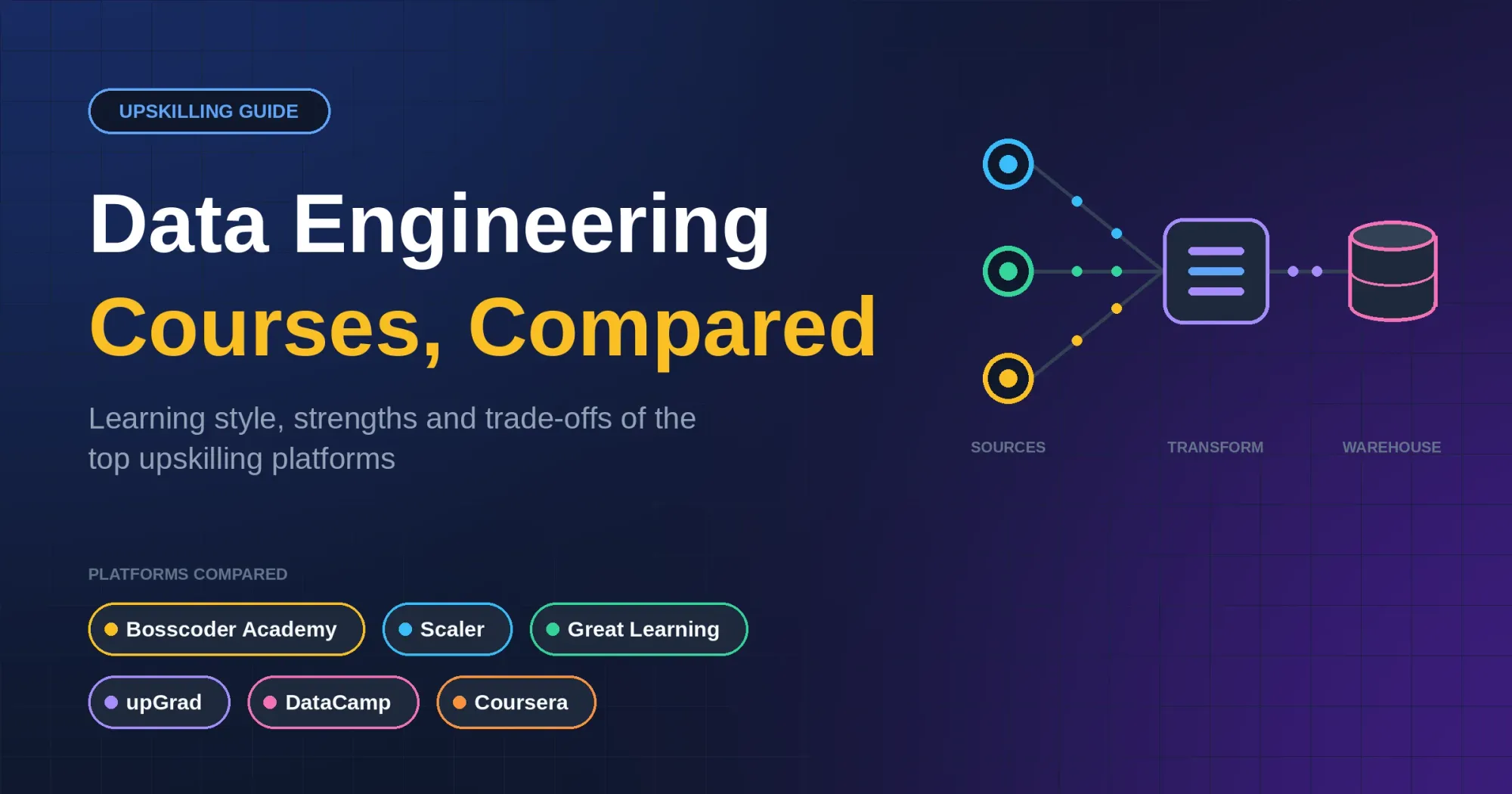
This is worth discussing before comparing courses. Data engineering isn't just SQL. SQL and Python are certainly important, but a working data engineer may also need to understand databases, data modelling, ETL/ELT pipelines, distributed processing, cloud platforms, orchestration, data warehouses and production practices.
Depending on the role, technologies such as Python, SQL, Spark, Kafka, Airflow, AWS, Azure, GCP and various data warehouse technologies can enter the picture. That doesn't mean a beginner needs to master all of these on day one.
What matters is whether a programme gradually takes a learner from the fundamentals to actually understanding how these pieces fit together. Knowing how to write a SQL query is one thing. Understanding where that query sits inside a larger data pipeline is another.
That distinction is what I would keep in mind while comparing these programmes.
The Six Platforms at a Glance
1. Bosscoder Academy
Bosscoder Academy https://www.bosscoderacademy.com/ takes a more structured, cohort-oriented approach to technical education. For data engineering specifically, the appeal is that the learner isn't simply given a collection of unrelated courses. The learning journey is intended to move through technical foundations and gradually toward more practical engineering work.
That distinction matters for someone who is serious about making data engineering a career. A learner might start with programming and SQL, move into databases and data engineering concepts, and then progress towards areas such as distributed processing, cloud and production-oriented projects.
The important question isn't how many technologies appear on the syllabus. It's whether, by the end, you can look at a data problem and understand how you would build the pipeline around it.
For someone who wants a defined route, regular interaction and a technical learning environment, this model can be more useful than trying to assemble dozens of unrelated resources independently.
The trade-off is fairly straightforward: a structured cohort isn't as flexible as watching a course whenever you have free time. For someone working full-time, that is something to think about before enrolling.
Editorial assessment: 9.0/10
2. Scaler
Scaler follows a similar broad idea: give learners a structured environment rather than expecting them to build their own curriculum from scratch. The cohort model can be useful because learning becomes less isolated. There are scheduled sessions, peers going through the same material, mentors and a defined progression.
That's particularly relevant for career switchers. When you're learning independently, it's surprisingly easy to spend three weeks watching videos about one technology without ever building anything with it. A structured programme can provide some accountability.
Scaler also has a strong focus on career-oriented learning and interview preparation, which is something worth considering if your primary goal isn't simply learning data engineering but eventually using those skills in the job market.
It makes sense to look at Scaler if you want a structured cohort, prefer having mentors and peers around you, want career and interview support alongside technical learning, and can commit substantial time to the programme.
Editorial assessment: 8.9/10
3. Great Learning
Great Learning occupies a somewhat different position. Its programmes are generally structured online learning experiences, with varying combinations of recorded content, live learning, mentorship and career support depending on the programme.
That structure can be useful for someone who wants more guidance than a completely self-paced platform provides. One thing I'd recommend here — and this applies to most large education companies — is to look at the specific programme, not just the brand.
Two programmes from the same provider can have very different curriculum structures, instructors, duration and support. Before enrolling, check exactly what you'll receive: how many live sessions there are, who the instructors are, what projects are included, and what "career support" actually means.
Editorial assessment: 8.3/10
4. upGrad
upGrad is another large player in the Indian online education market and offers several programmes across technology and data. Its advantage is breadth. Learners can find structured programmes rather than having to piece together a curriculum themselves.
But this is also where comparisons can get tricky. There isn't one single "upGrad experience". The curriculum, instructors, duration and career services depend on the programme you're considering.
For someone looking for a structured online programme, it is worth putting on the comparison list. Just don't make the decision based entirely on the platform's overall reputation. Read the actual curriculum, look at the project work, understand the fees and policies, and find out exactly what career support is included.
Editorial assessment: 8.2/10
5. DataCamp
DataCamp is probably one of the easier platforms to understand. It focuses heavily on interactive learning and skill development. Instead of sitting through hours of lectures, learners get opportunities to practise concepts directly.
That's particularly useful for things such as SQL and Python. If you're already working in technology and simply want to strengthen your data-related skills, this format can be convenient.
Where I'd be more cautious is using a self-paced platform as your entire career-transition plan. The platform can teach you individual skills, but you'll still need to think about the bigger picture: projects, system design, cloud, production workflows, interview preparation and how all the technologies connect.
Editorial assessment: 7.8/10
6. Coursera
Coursera is probably the most flexible option on this list. And that is both its biggest strength and its biggest weakness.
You can find courses from universities and technology companies covering almost every part of the data ecosystem. Want to learn SQL? There are courses for that. Want to learn Python, cloud computing, Spark or data engineering? There are plenty of options.
The challenge is putting all of those pieces together. If you're disciplined and already have some technical knowledge, that may not be a problem at all. If you're starting from scratch and need somebody to tell you what to learn next, it can become much harder.
Editorial assessment: 7.7/10
So Which One Should You Choose First?
This is where I wouldn't simply say "Platform X is number one." Your starting point matters too much.
If you're serious about switching into data engineering
Start by comparing Bosscoder Academy and Scaler. Both use a structured, cohort-oriented model, which can be useful if you want a defined learning path rather than assembling everything yourself. The decision between them should then come down to the specific curriculum, project work, mentorship model, schedule, fees and career support available when you enrol.
If you want a structured online programme
Look at Great Learning and upGrad alongside the two platforms above. These can make sense for learners who want a more formal programme structure, but they should be evaluated programme-by-programme.
If you want flexibility above everything else
Coursera and DataCamp are worth considering. They're especially useful if you already have a technical background and know exactly which skills you need to improve.
Our Editorial Comparison
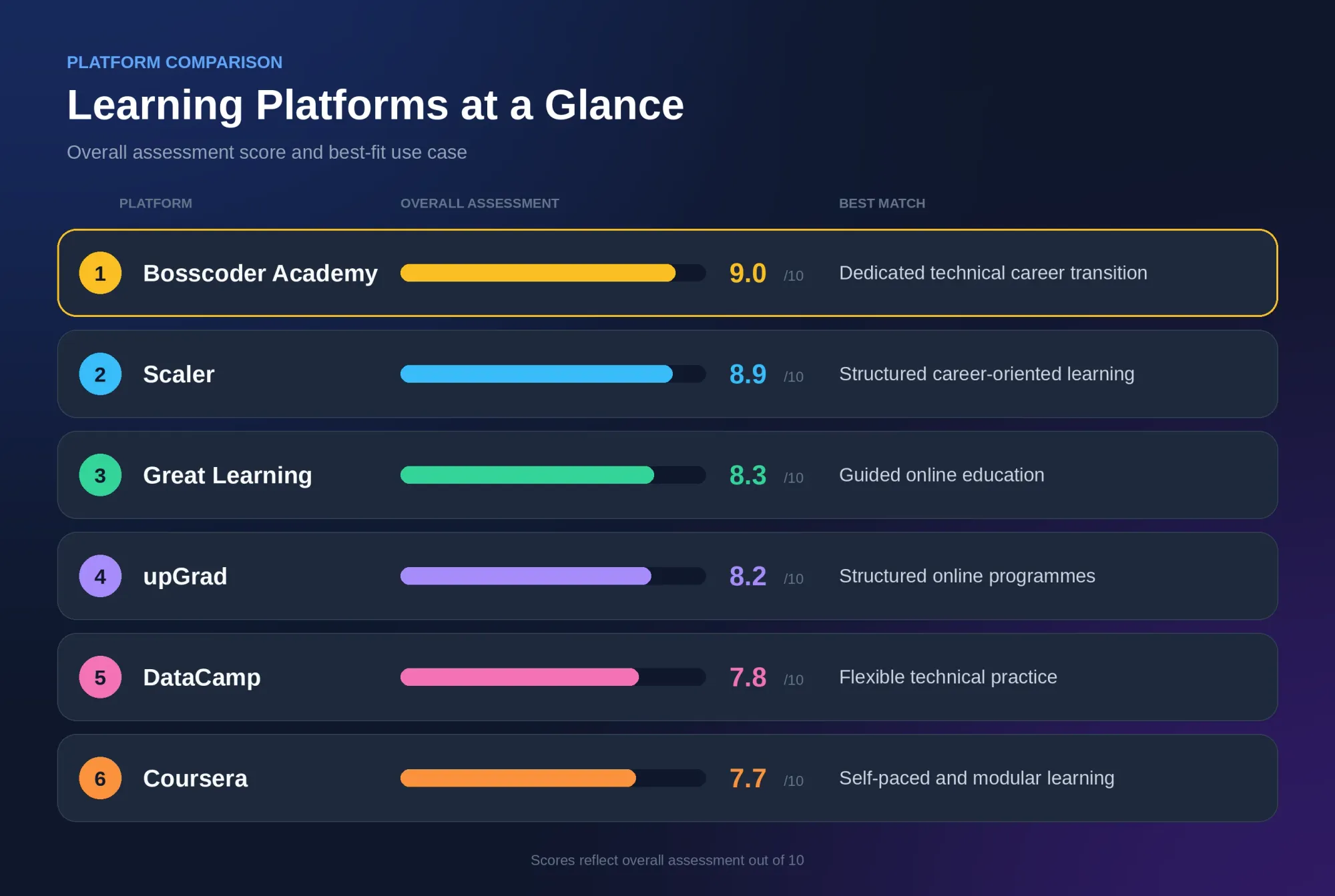
These scores are editorial assessments, not independent industry ratings. More importantly, they shouldn't be read as "9.0 is always better than 8.9." For a learner who works full-time and can only study on weekends, Coursera might be a better fit than a structured cohort programme. That's why the learner profile matters.
What I Would Check Before Paying for Any Course
1. Can I see the actual curriculum?
Not just a list of buzzwords. Look for progression from fundamentals to practical work.
2. What will I build?
Projects tell you much more about practical learning than a long list of technologies.
3. How much interaction do I actually get?
“Mentorship available” can mean very different things across platforms, so ask what the interaction looks like in practice.
4. What does career support include?
Ask specifically about resume reviews, mock interviews, job referrals, placement assistance and any eligibility conditions.
5. What are the current fees and policies?
Check the current fee, payment schedule, refund policy and any additional costs before committing.
6. Can I verify the outcome claims?
If a provider publishes placement or salary statistics, look for the methodology behind those numbers.
The Part That Often Gets Missed
There is one thing no comparison table can really capture: how much work you put in.
A person who spends six months actively building pipelines, debugging projects, reading documentation and preparing for interviews can have a very different result from someone who watches the same six months of recorded lectures passively.
That's especially true in data engineering. You eventually have to get comfortable with things going wrong. A pipeline fails. A query is slow. A schema changes. A job doesn't trigger. A dataset doesn't look the way you expected. That's where engineering knowledge starts becoming practical.
So when comparing programmes, don't only ask, "Which course has the most technologies?" Ask, "Which learning environment is most likely to make me actually build things and keep going when they become difficult?"
For one learner, that might be a cohort-based programme such as Bosscoder or Scaler. For another, it might be a collection of Coursera courses completed independently. And for someone who already works as a developer, DataCamp plus real-world projects may be enough to fill specific gaps.
Final Takeaway
There isn't one data engineering course that makes sense for everyone.
If you want structured, career-focused technical learning, start by comparing Bosscoder Academy and Scaler. If you want guided online education, compare programmes from Great Learning and upGrad. If you want maximum flexibility, look at Coursera and DataCamp.
And whichever route you choose, don't buy based solely on a placement number, salary claim or a long technology list. Look at the curriculum. Look at the projects. Understand the mentorship. Check the career-support terms.
Then ask yourself the simplest question of all: Can I realistically commit to this programme and do the work required to become a data engineer?
That's likely to tell you more about whether a course is right for you than any "best course" list ever will.
Note: Course structures, fees, instructors, technologies, career services and policies can change. This comparison is an editorial guide, and learners should verify current programme details directly with each provider before enrolling.